DUCKDUCKGO INSTALLS SURGE 30% AS USERS TURN AWAY FROM GOOGLE AI SEARCH
Google has just faced intense backlash from users after announcing plans to completely replace traditional search result lists with <strong>AI agents at Google I/O 2026. The direct consequence: DuckDuckGo — the privacy-focused search engine — recorded a 30% surge in US app installs within just one week of Google's announcement.</strong>
This is a clear signal that users are actively seeking alternatives when "forced" to use AI Search. Gabriel Weinberg, CEO of DuckDuckGo, stated: "We don't just respect user choice; we also respect their privacy. Everything you do on DuckDuckGo is private — we don't collect search or chat history, and nothing is used to train AI."
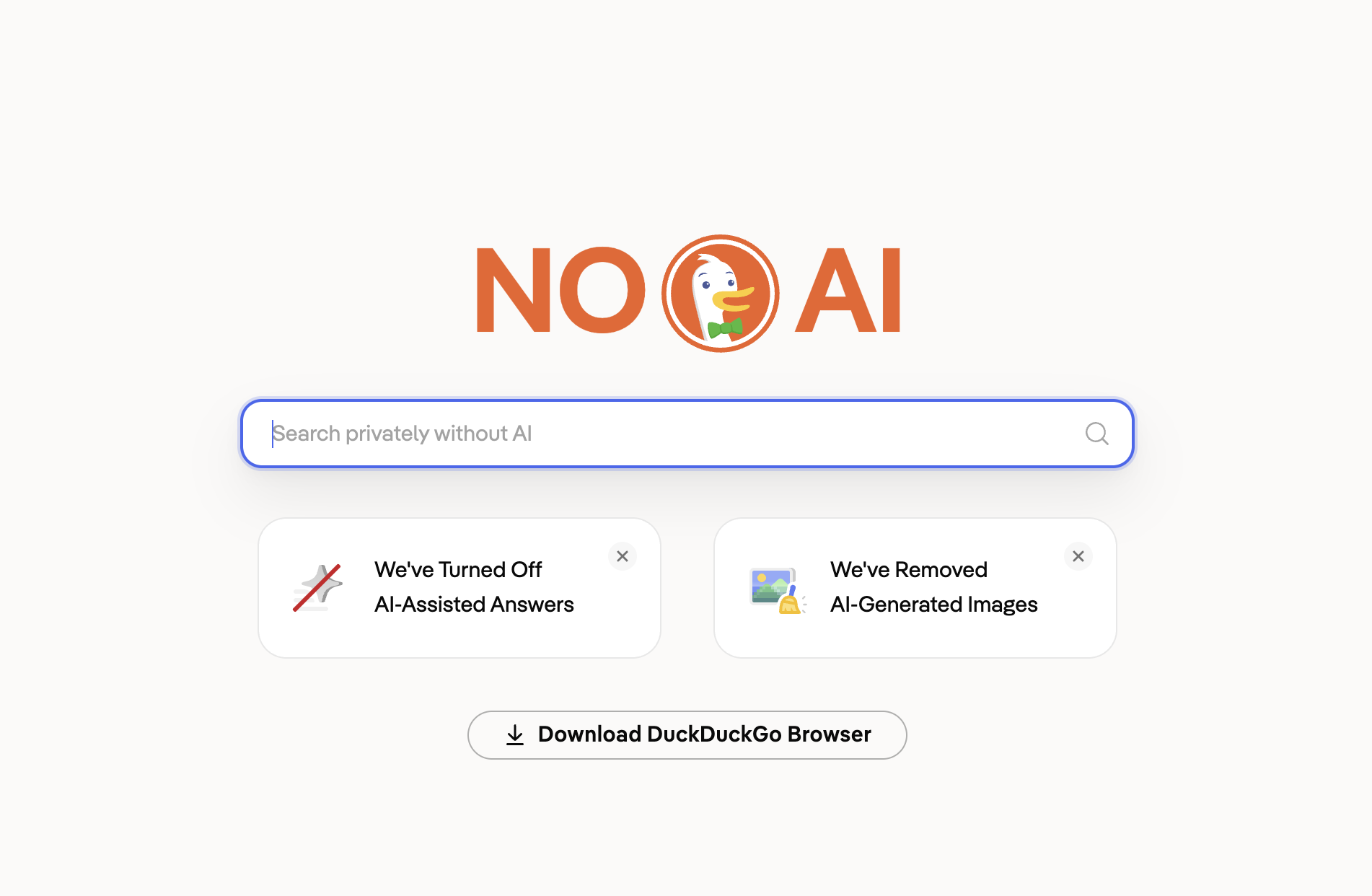 DuckDuckGo is attracting users with its commitment to not forcing AI Search. Photo: DuckDuckGo
GOOGLE I/O 2026: THE CONTROVERSIAL SEARCH OVERHAUL
At the Google I/O 2026 conference, Google announced a landmark change: traditional blue-link search result lists will be completely replaced by AI agents. These agents not only answer questions but also automatically execute tasks and run background monitoring agents — transforming Google Search from a lookup tool into a comprehensive AI assistant.
This is Google's biggest ambition in search since launching AI Overviews in 2024. However, instead of being welcomed, the move met a wave of criticism from Google's own most loyal users. Many feel they are being "force-fed" AI Search with no option to return to the familiar search interface.
One user shared on social media: "Google isn't Google anymore." This brief statement accurately reflects the sentiment of millions of users feeling alienated from the search engine they have relied on for over two decades.
WAVE OF BACKLASH AND THE RISE OF DUCKDUCKGO
According to official data from DuckDuckGo, US app installs rose by an average of 18.1% week-over-week during May 20–25, 2026, compared to the previous week (May 13–18). The growth was sustained continuously for 6 days and peaked at 30.5% on May 25.
On iOS, the growth rate was even more impressive: averaging 33% week-over-week and peaking at 69.9%. Notably, DuckDuckGo continued to attract new users even during the Memorial Day holiday — a period that typically sees lower traffic. This indicates that the shift is not just a temporary reaction, but shows signs of sustainability.
Kamyl Bazbaz, VP of Communications and Policy at DuckDuckGo, noted: "People simply want to have a choice." DuckDuckGo is positioning itself not as a direct competitor in AI technology, but as a user-respecting alternative.
DUCKDUCKGO AI: NO COMPROMISE ON PRIVACY
Unlike Google, DuckDuckGo takes a non-intrusive approach to AI and privacy. The company offers Search Assist — a feature similar to Google's AI Overviews, but without collecting user data for model training. Additionally, DuckDuckGo provides AI Image Filter — a filter that removes AI-generated images from search results.
Interestingly, both of these AI features rank among the most popular with users on DuckDuckGo, despite their differing philosophies — one assisting with AI, the other filtering AI out. This proves that users are not against AI; they are simply against being forced to use AI without a choice.
Gabriel Weinberg further emphasized: "Everything you do on DuckDuckGo is private. We don't collect search history or chat history, and nothing is used to train AI." This commitment carries particular weight as users grow increasingly concerned about personal data being harvested to train large language models.
THE FUTURE OF SEARCH: CHOICE OR COERCION?
DuckDuckGo's 30% growth raises major questions about the future of the search market. Is Google moving too fast in the AI race? With over 90% of the global search market share, Google might feel confident that users have no other choice — yet DuckDuckGo's numbers suggest otherwise.
Experts believe that 2026 could be a turning point for the search engine market. As AI becomes more deeply integrated into the search experience, the line between "utility" and "intrusion" is thinner than ever. DuckDuckGo, Brave Search, and other privacy-focused search engines face a historic opportunity to expand their market share.
TechCrunch has reached out to Google for comment regarding the backlash and DuckDuckGo's growth figures. Google has not yet issued an official response. However, with pressure from users and competitors, Google may have to adjust its AI Search strategy — potentially by offering an option to turn off AI for users who prefer not to use it.
Source: TechCrunch — DuckDuckGo installs are up 30% as users reject being 'force-fed' Google's AI Search