Google I/O 2026: Google Makes AI Agents the New Operating Layer of the Internet
Google I/O 2026 this year delivered a clear message: AI is no longer just a tool for Q&A, content writing, or image generation. Google is pushing its entire ecosystem into a new phase where AI can act as an “operating layer” standing between people and their daily digital tasks. Whereas a few years ago users had to open individual apps, enter each command, copy snippets of data, and manually connect every step, Google’s post-I/O 2026 direction is for AI to understand the goal, break down the work, coordinate across tools, and return results in a ready-to-use format.
This is why Google I/O 2026 matters not only to the tech community, but also to small business owners, marketers, content creators, freelancers, consultants, and teams looking to operate more leanly. Google’s announcements show that the AI race is shifting from “who has the smartest chatbot” to “who has the most practical AI operating system.”
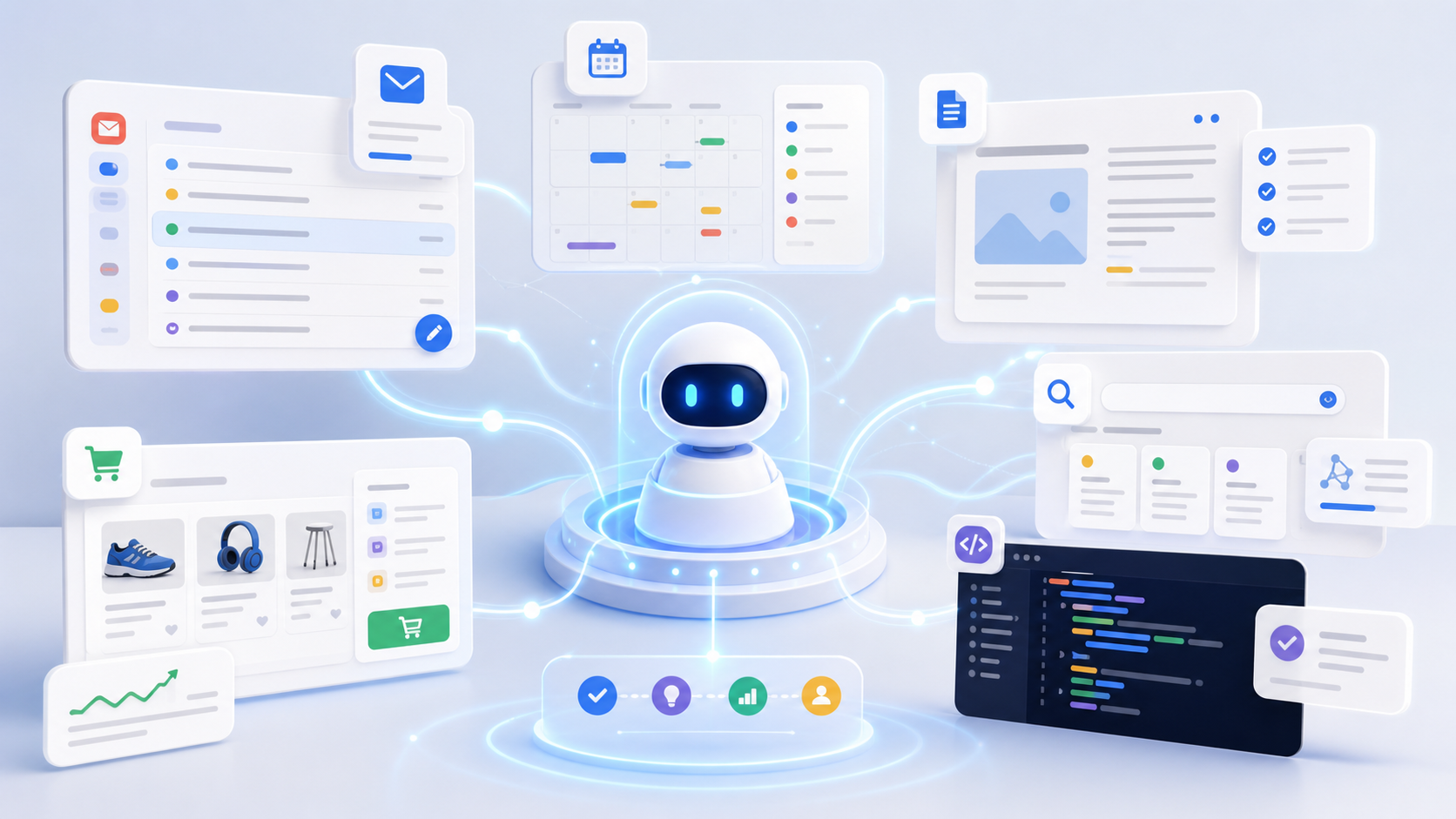 Google I/O 2026 highlights the AI agent direction: AI doesn’t just answer, it helps execute the work.
Gemini 3.5 Flash: the speed foundation for the AI agent era
The first centerpiece is Gemini 3.5 Flash. According to Google, this is the first model in the new Gemini generation that combines “frontier intelligence” with fast execution capabilities. Put simply, the model is not only strong at reasoning, understanding context, and multimodal processing, but is also optimized for multi-step, multi-tool workflows that require rapid responses.
Notably, Google did not introduce Gemini 3.5 Flash as a demo-only model. It is being rolled out across the Gemini app, AI Mode in Google Search, the Gemini API, Google AI Studio, Android Studio, and the Google Antigravity platform. This rollout shows Google wants to make the new model a “shared engine” for its flagship products rather than keeping it isolated in a lab.
For businesses, this means tasks such as writing briefs, analyzing customer data, creating campaign outlines, drafting emails, planning content, auditing websites, assisting with coding, or generating reports can gradually be connected into end-to-end workflows. Instead of each AI tool handling only a single fragment, an AI agent can understand the ultimate objective and move autonomously across multiple steps.
Gemini Spark: from AI assistant to a 24/7 “digital teammate”
Another standout announcement is Gemini Spark, which Google describes as an agent that helps users work more proactively—even running tasks in the background. This is a major product shift. Traditional chatbots require users to ask one question at a time. AI agents, by contrast, are given a broader goal: monitoring, preparing, summarizing, reminding, drafting documents, researching information, or offering suggestions at the right moment.
Applied to a small business context, Gemini Spark paints a picture of an always-on digital assistant: summarizing industry news in the morning, reviewing the meeting schedule at noon, drafting emails in the afternoon, and proposing social media posts for the next day in the evening. Of course, businesses still need humans to review, make decisions, and take accountability. However, repetitive tasks, preparation, and “data gathering” can be automated far more deeply.
This also aligns well with the “one-person business” or “micro-team” model that many are pursuing. A single individual does not necessarily have to do everything by hand. Instead, they need to know how to design systems, delegate to AI, ensure quality control, and focus on strategy.
Search is transforming into an action engine
Google Search is undergoing major changes as well. Google shared that AI Mode has surpassed one billion monthly users, and at I/O 2026, Search was upgraded in a more agentic direction. Instead of simply returning a list of links, Search will be able to generate tailored response interfaces for each query, support multimodal search, handle longer questions, and in some cases help users complete tasks rather than just read information.
This shift directly impacts SEO and content marketing. As users increasingly receive synthesized answers right inside AI Mode, website content can no longer be written just to “rank for keywords” in the old way. Businesses need to create content with depth, real data, expert perspectives, and a clear enough structure for AI to understand. The more generic an article is, the easier it is for AI to summarize and replace it. The more an article features real-world experience, case studies, market insights, and a distinct point of view, the greater its chance of becoming a cited reference.
For JAYbranding, this is an important signal: in the AI Search era, a corporate website must serve human readers while also acting as a “structured knowledge source” for AI systems. Content is no longer decorative filler for SEO—it is a brand’s data asset.
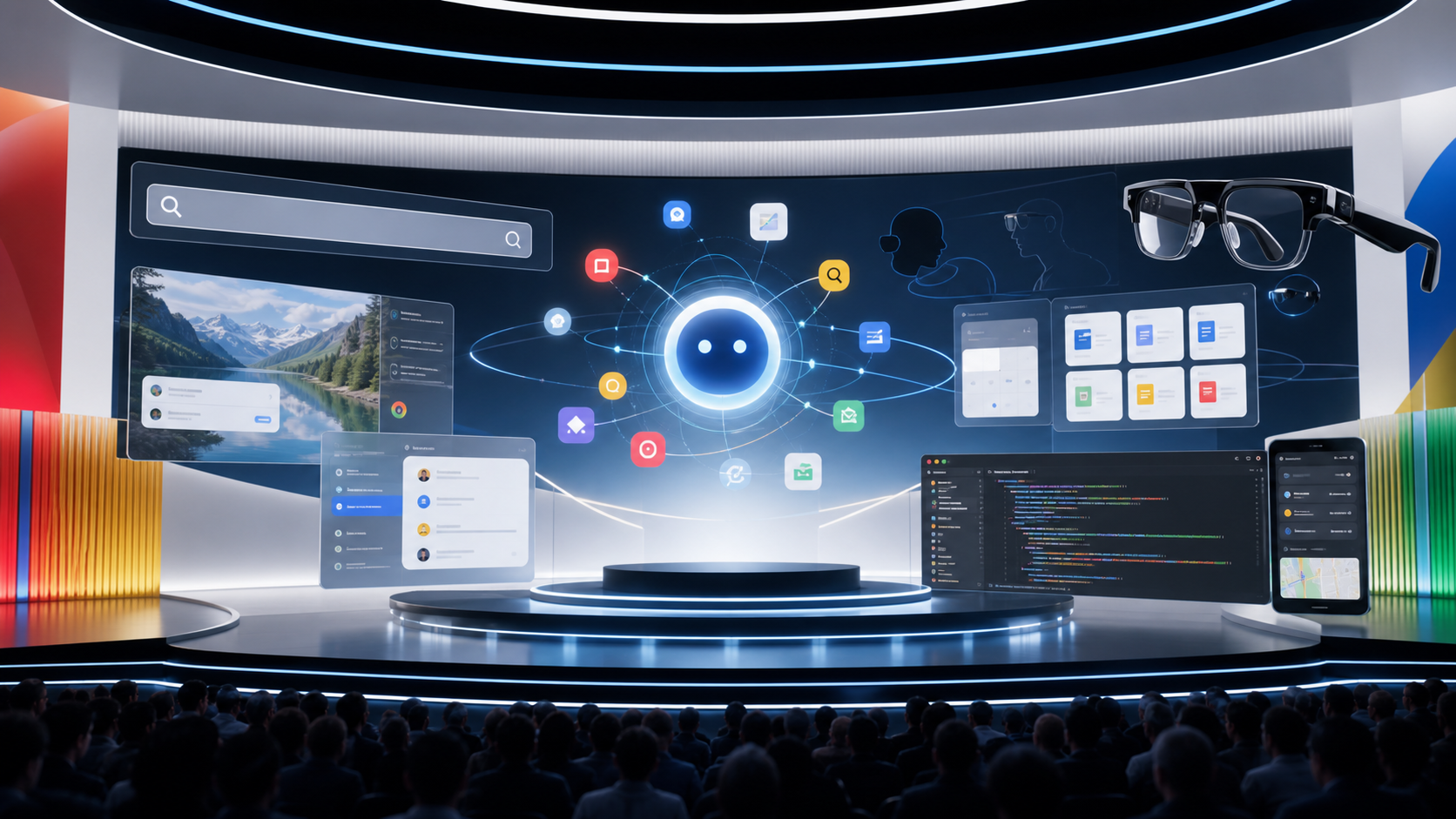 Small businesses will feel a strong impact from AI Search, Workspace agents, shopping agents, and new software development tools.
Universal Cart: shopping gets the agent treatment
Another area worth watching closely is e-commerce. Google introduced Universal Cart, a smart shopping cart concept designed to work across Search, Gemini, YouTube, Gmail, and Google Pay. The idea is that AI does not just find products—it also tracks prices, checks inventory, recommends suitable options, compares deals, and assists throughout the purchasing process.
This could reshape how online sellers reach customers. Previously, businesses optimized landing pages, ran ads, and drove users to their websites to browse on their own. In the near future, many purchasing decisions may happen through an intermediary AI layer. Users state their needs, AI filters the options, and then recommends products. When that happens, product information must be clear, data must be standardized, pricing must be transparent, visuals must be strong, reviews must be credible, and the brand must carry strong trust signals.
In other words, if AI becomes the customer’s “shopping advisor,” businesses must optimize not only for human eyes, but also for how AI reads, compares, and understands products.
Workspace, voice, and Daily Brief: working through conversation
Google is also expanding Gemini into Workspace in a more natural way. Experiences such as summarizing, drafting, organizing information, prioritizing emails, preparing documents, and voice assistance show that Google wants to reduce the friction between an idea and a finished deliverable. For many business professionals, the hard part isn’t always “not knowing how to write,” but dealing with fragmented information across phone notes, emails, Google Docs, calendars, messages, client briefs, and internal reports.
If AI can pull these scattered pieces together into a summary, checklist, proposal, action plan, or content draft, individual productivity jumps significantly. This is a huge opportunity for small businesses, which often lack dedicated operations staff yet face heavy daily administrative and communication workloads.
Antigravity 2.0: software development powered by a team of agents
For developers, Google introduced several updates for Google Antigravity, including the 2.0 desktop app, CLI, SDK, and Managed Agents in the Gemini API. Crucially, Google is positioning software development as a workflow that can be distributed across multiple agents simultaneously: one agent writes code, one runs tests, one prepares documentation, and another generates assets or reviews bugs.
This is not just a story for software engineers. As the cost of building software drops, more small businesses can build internal tools much faster: a simple CRM, quoting system, marketing dashboard, lead capture form, order management tool, or customer support chatbot. Previously, these required a dedicated technical team; soon, someone who understands the business workflow can collaborate with AI to build a first version far more quickly.
Smart glasses and Android XR: AI steps off the screen
Google also highlighted intelligent eyewear and Android XR. While these may not become mass-market products in Vietnam immediately, the strategic signal is unmistakable: AI will not stay confined to a web browser or chat app. It is moving into wearables, cameras, audio, workspaces, and real-world environments.
When AI can see, hear, understand context, and respond in real time, the way people work, learn, shop, and interact with brands will continue to evolve. For marketing, this raises a new question: how will a brand show up in an environment where users have an AI layer beside them at all times?
How should Vietnamese businesses prepare?
Following Google I/O 2026, there are three things Vietnamese businesses should do right away. First, standardize your data and content. Websites, service profiles, pricing tables, FAQs, case studies, and product details need to be written clearly, structured logically, and easy to read and cite. Second, integrate AI into real operational workflows—not just for writing a few social captions. Start with repetitive tasks: drafting emails, summarizing meetings, scheduling content, qualifying leads, answering basic inquiries, and generating reports. Third, build an “agent-ready” mindset: every process should have clear inputs, clear outputs, and clear review criteria so parts of it can later be handed off to AI agents.
Most importantly, do not treat AI as magic. AI accelerates execution, but businesses still need strategy, positioning, accurate data, solid processes, and human accountability. Those who prepare early will gain a major advantage, because as AI agents become mainstream, the market’s response speed and operational capacity will rise across the board. A slow, fragmented business lacking clean data will struggle to compete against a lean business that knows how to automate smartly.
Conclusion
Google I/O 2026 points to a very near future: AI no longer just answers questions—it actively participates in work, search, shopping, content creation, and software development. For JAYbranding, this is the moment for businesses to audit their entire digital ecosystem: is your website clear enough for AI to understand, is your content valuable enough to be cited, are your workflows streamlined enough to automate, and is your brand trustworthy enough for AI to recommend to customers?
In the AI agent era, the advantage does not belong to the biggest company, but to the company with the clearest systems, cleanest data, and most practical AI adoption.
References
- Google: 100 things announced at I/O 2026
- Google Search I/O 2026 updates
- Google I/O 2026 developer highlights
- The next evolution of the Gemini app
- Android XR and intelligent eyewear at I/O 2026